

 Spotify
 Apple Podcasts
 Amazon Music
 iHeartRadio
 RSS Feed
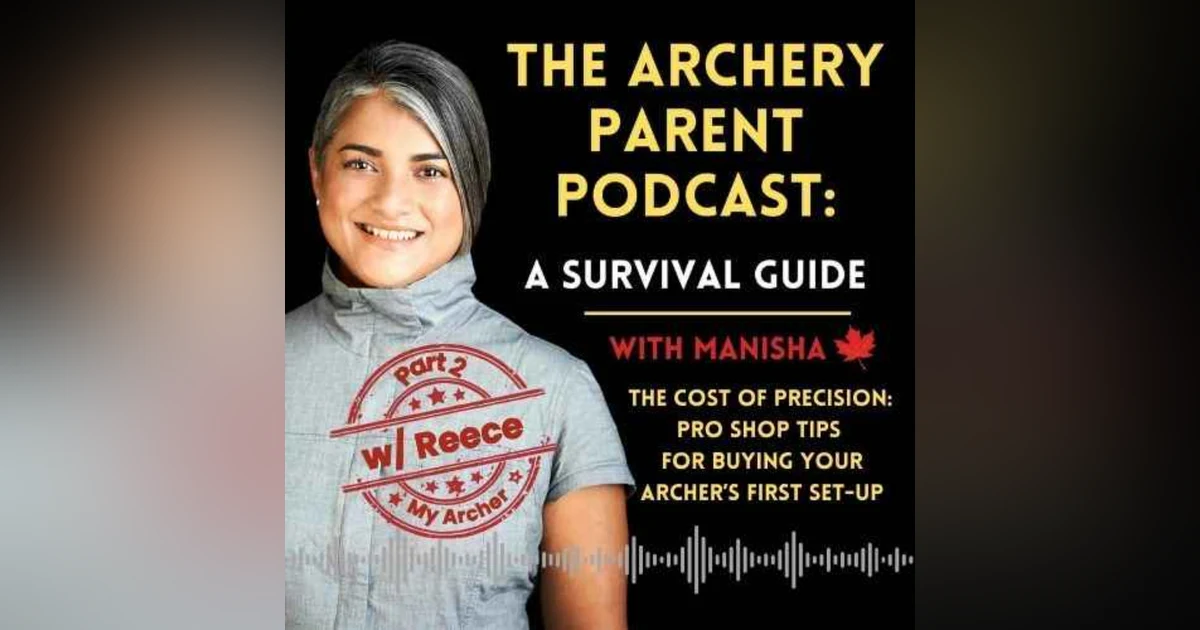
 The Cost of Precision: Pro Shop Tips for Buying your Archer's First Set-up
A Beginner’s Guide to First-Time Bow Costs, Essential Gear & Tips for New Archery Parents
Archery Equipment 101: Pro Shops, Set-up Costs, Used Gear, and Arrow Basics with Reece
In Part Two of my conversation with my Archer (& Pro Shop Staff) Reece, the discussion shifts from shoes to Archery equipment, emphasizing the value of supporting and learning from local pro shops versus big box stores through personalized fitting, trying gear, set-up, and tuning for comfort and consistency.
Reece outlines typical costs for set-ups (in CAD$), budget options, bow components, and a whole lot of information about arrows: arrow progression, spine measurements, arrow lengths and cutting, DIY arrow-saw considerations, fletching tools, and parts of an arrow. We end the episode with Reece’s travel essentials and the beauty of Archery as a lifelong sport.
Be sure to get caught up, if you missed Part 1 with Reece: "Shoes that Stabilize: Reece's Range-Tested Picks".
00:00 Welcome Back Reece
00:12 Shoes Recap Advice
01:00 Why Pro Shops Matter
03:33 Comfort And Fit Checks
04:51 Recurve Set-up Costs
07:10 First Set-up Breakdown
08:23 Clicker Timing Debate
11:13 Buying Used Gear Safely
13:21 Arrows & When to Upgrade (… & Why Not To)
14:45 Arrow Spine Numbers: What it All Means
20:04 Arrow Length Cutting
26:00 Fletching Tools
28:35 Arrow Parts Explained
31:17 Compound & Barebow Costs
34:50 Travel Essentials & Conclusion
----
💡 Top Tips for Buying Equipment
- Prioritize Comfort Above All Else: When trying out gear at a pro shop, always ask your Archer (or yourself), "Is it comfortable?". If a bow feels too heavy, a grip feels wrong, or the draw length is misaligned, the fun will fade quickly.
- Let the Riser Grow with Your Archer: Investing in a machined riser at the start gives a solid foundation. You can easily save money on entry-level limbs or accessories first and upgrade those pieces down the road.
- Buy Arrows Stiff for Long-Term Savings*: If your Archer plans to slowly increase their draw weight over time, a pro shop can set them up with arrows that are a little stiff to start. These arrows will work well in the future, saving you from buying a completely separate set of arrows a few months down the line.*NOTE: This is a decision between you, your Archer, their Coach, & pro shop staff. It could be a frustrating time as your Archer adjusts.
- Inspect Online Used Gear in Person: Dedicated Archery forums have some amazing gems, but it can be a major risk. Always examine used items carefully for hidden damage like bent limbs, scuffed risers, or cracked arrows.
- Don't Rush the Clicker: A clicker is an incredible tool for draw length consistency, but introducing it too early can turn it into a mental distraction. Wait a few months until your Archer's alignment, follow-through, and shot timing are rock solid.
🔗 Places, Gear, & Communities Mentioned in this Episode
Pro Shops & Facilities:
- The Bow Shop / Shooter's Choice (Waterloo, Ontario): The local pro shop where Reece has worked for the past five years
Trusted Online Forums & Communities for Used Gear:
Gear Mentioned in the Episode:
Bows & Risers: Sebastien Flute (This was Reece’s beginner set-up.)
- SF Explorer Riser
- SF Axiom Limbs
Arrows: Easton
- Easton Inspires (Perfect beginner indoor arrow)
- Easton Avance (great mid-tier target arrow that replaced the Carbon One)
- Easton X10 (The elite, premier Target Archery standard)
Fletching Jigs, Tools & Vanes:
- Bitzenburger Fletching Jigs
- Last Chance Jigs
- Beiter Tri-Liner
- Range-O-Matic Spin Wings
- Jet6 Vanes
- Spider Vanes
Reece's Travel Essentials: A Theragun (for keeping shoulders and neck loose) and noise-canceling headphones
Keywords: Reece Wilson-Poyton | Archery | Expert Archery Advice | How to Buy a Bow | Archery Pro Shop | Compound Archery | Olympic Recurve Archery | Barebow Archery | Buying Archery Equipment | Bow and Arrow
Hosted on Acast. See acast.com/privacy for more information.
The Cost of Precision:
Pro Shop Tips for Buying Your Archer's First Set-up
Manisha: Hello, Archery Family. This is Part Two of our chat with the most special guest, my Archer, Reece. Hey, Reece.
Reece: Hello again.
Manisha: So our last chat was about shoes and we talked about the types of shoes that make a good Archery shoe. Was there anything else that we should have mentioned? Was there anything that we skipped or forgot to talk about?
Reece: Not necessarily. I think it was pretty, pretty all-encompassing. I would maybe say the only thing that I maybe could have mentioned as well was when we were talking about the priority of shoes. I think maybe I would say when you're starting, just get whatever's comfortable. Don't try to force yourself into anything in particular.
Just get something comfortable and then, like you said, as you progress and you're more aware of what you're doing, having a good balanced pair of shoes is more important. But I would just say at first, just wear whatever's comfortable and just make sure you are comfortable and you're having fun.
Manisha: That's great. Thanks. Now, this episode is Part Two. It's going to be about equipment. Let's first start with why is it a good idea to work with a local Archery shop, if there is one relatively close to you, or even online, opposed to a big box store? Why is that maybe a more wise choice for someone who's just starting out?
Reece: It's always important to support local. Try and support the small businesses, which most pro shops are. And there's very few pro shops out there that can survive without your support, so I think that's certainly part of it. I mean, we've seen throughout the last few years through COVID and how difficult it was for pro shops then.
More recently, with all the economic stuff going on, it's been very difficult for a lot of stores. A lot of stores that I know of have been able to keep going and persevere through. And, it's been great to see a lot of people rallying around a lot of the stores. But certainly it can be difficult, as well, if maybe your shop doesn't carry everything you want.
But yeah, I think even though maybe it might take a little bit longer for it to come in from your local place, if they don't maybe have it all the time, I think it's still important because that store still needs your business, and as long as you don't mind waiting a little bit, it goes a long way for sure.
Manisha: And what are the advantages of working with a local shop that can help with the education piece for an Archer and their purchasing parents?
Reece: Yeah, I mean, building a rapport with your local store and shop is very important. Definitely giving them the opportunity to help you a little bit more with, like you said, learning about the sport, learning about what equipment it is you are actually using, why it might be valuable to you, and how it might help you to take care of your equipment, whether it's just kind of general maintenance, which in our sport we're fortunate there's very little of, apart from really just your string and your arrows, how to tune your equipment efficiently and appropriately.
And, yeah, just to recommend things that might give you a little bit more of an edge or a little bit more consistency, because certainly that's the name of the game in our sport is consistency.
Manisha: When you first started, we went to a place that is near and dear to both of our hearts, the Bow Shop/Shooter’s Choice in Waterloo, a place that you now work at.
What was amazing was how open the staff was to helping us, but also to open packages and actually try the equipment. I think it was like a five or five and a half hour visit.
Reece: It was a while, yeah.
Manisha: James said to us, "You're making this investment. We want to make sure that you're leaving with the right stuff."
Reece: Yeah, I think especially in our sport, it is such a personalized sport and very specific to the Archer, and all of us have different preferences. All of us have different ideas and thoughts and ways that we might want to go about it. And so being able to try the equipment and make sure that firstly it's comfortable.
When I'm working at the shop now, that's one of the biggest questions I'm always asking people is, "Is it comfortable?" because if it's not comfortable, you're probably not going to enjoy it. And if you're not enjoying it, you're not having fun, and then you might not want to continue in the sport. So making sure it's comfortable.
Manisha: What does that mean? Where's the comfort coming from?
Reece: I think a lot of it is just, is it too heavy? Is it a challenge to shoot the bow or lift the bow or maneuver the bow, anything like that. If you're using a tab or a release, depending on if you're shooting Compound or Recurve, respectively. Does it fit your hand appropriately?
Is it too tight? Is it too loose? Are you hitting your arm? Okay, let's get you an arm guard. Let's maybe fix your grip. Make sure you’ve got ample room there so that you're not whacking your arm all the time or anything like that. Making sure that you're comfortable, which is a very general term, and there's a lot that goes into feeling, quote-unquote, comfortable, when you're shooting your bow.
That's kind of one of the biggest things, especially, yeah, on compound as well. Like, is, is your drawing too short? Is it too long? You're not overdrawing or, or anything like that.
Manisha: Let's talk about money. So when you and I went into the Bow Shop, I had no idea what this would cost. Can you just run through on the Recurve side for now, someone coming in with an Archer, what can they expect to pay, to invest?
Reece: Yeah, I mean, normally on the Recurve side of things, if you want to get into Olympic Recurve with a proper aluminum or metal riser, carbon limbs, the slightly nicer stuff than just a simple wooden bow, I normally say around 800, or so, is a really good starting point. You can get a really nice riser that you can build around.
You can still get maybe a half decent sight, a tab, maybe a half dozen to a dozen arrows. But there are lots of ways, if that's a little outside of your budget, that's perfectly fine. We can very easily lop off 100 to 200 bucks sometimes by just going to a cheaper riser that's a cast riser instead of a machined riser.
That's a very simple way to, to lower the cost. That's what I did with my first bow. I went for a, a cast riser instead of a forged riser, which I think...I remember almost to the dollar how much I spent. It was, like, $541, I think, and however many cents after tax. As I remember, I did some research ahead and found all the things that I wanted to get and did the math, and I think I still have the note in my phone still somewhere
And yeah, so it was a bit over $500, I believe. And when we left the store, I think that was about how much I spent because that was about as much as I had saved up. That is still a price point today that we'd be maybe cutting a few corners, maybe changing a few things, or saving a couple things for down the road to upgrade to a simple rest instead of a proper wire rest and plunger set-up.
We can always save a couple bucks here and there if, if you're on a bit of a tighter budget, but there's always something for everybody. I mean, if that's not the route you want to take, and you want to just kind of do it for fun too, I mean, I can get people into the sport for 200 bucks, 300 bucks, or maybe even less sometimes if we go more into the used side of things, which is also sometimes a perfectly valid thing to do if you kind of either know what you're looking at, or with the assistance of someone at a pro shop to know if that is a good choice or a valid choice that you can kind of grow with or it can grow with you.
So that's also another way certainly to help a little bit with the end price.
Manisha: For your very first set-up, what did you walk away with for $500 or $541?
Reece: I walked away with a fair bit. I had the riser, of course. It was an SF Explorer riser, I believe it was. I had a set of SF Axiom limbs.
I had a string, of course, which are relatively cheap. Had just a simple stick-on rest, I believe. I didn't... Or no, I did have a wire rest. And,, at the time, they were doing a promotion where you'd get the plunger and the rest included with the purchase, I believe it was, so I saved a couple bucks there.
But it was just a very entry-level rest and plunger. And then I got also a entry-level sight, and I got a front bar stabilizer as well. And then I got a quiver, I think a half dozen arrows, and an arm guard, and a tab. And then I think I got a backpack, as well, to throw everything in. It was, yeah, pretty much everything I needed to get started.
They did all the set-up and tuning, general entry level set-up-wise to make sure that the bow was good for me to shoot. I left the store knowing that if something went wrong, it was probably not the bow's fault.
Manisha: So at what point did you start with a clicker? Because you didn't mention a clicker in that list.
Reece: For Recurve Archers, a clicker is very important. It's a extremely useful tool, which is, in my opinion, kind of funny for how simple it is. And, it's certainly one of the cheaper things on a Recurve bow that we use, but arguably the most important. For, I guess, people who don't know a clicker, it's generally just a piece of spring steel that we screw onto the riser, and the arrow goes underneath it.
And as you draw back, eventually the tip of your arrow will come past the clicker. And, then we call it a clicker because it normally has a little, piece of plastic maybe on the end, or some people do different things. I put a little bit of shrink wrap actually on mine to even kind of dull the sound.
When you pull your arrow past it, it clicks and hits against your riser, makes a clicking sound, and we know that we can then shoot. This makes it so our draw length is always consistent. We're always drawing to the exact same distance every time so that we're not changing the amount of draw length we have and how much energy goes into the arrow.
When to put on a clicker is kind of a very, I guess, hotly debated topic. Some people want to jump in using a clicker right away. Some people want to leave it for a fair ways down someone's journey in the sport. And, I'm only talking like a couple months, maybe six or something like that in some cases.
I'm certainly a proponent for waiting. When I am coaching people, I generally wait a fair while and make sure that there's a lot of other aspects of their shot that we've ironed out to a solid degree. Not, like perfect, but making sure that a number of aspects of how they're shooting is pretty solid before putting on a clicker, because a clicker can become certainly a very large distraction, as well, if you're just constantly waiting for the clicker, like, "Oh, when's it going to go?"
And anticipating it, or at worst even is looking at the clicker and watching it click, and then you react and jump it, or anything like that. So a clicker is an extremely useful tool, but can also be a Recurve Archer's worst enemy. So I definitely am more of a proponent for waiting a couple months into someone's journey, if they're getting consistent coaching.
I definitely add it to someone's bow a decent while in. I did it recently with a student. They were shooting quite a lot, seeing them weekly, and we just recently put it on. I thought that they were doing things very well. They had a pretty good follow-through already. They had really good alignment and pretty consistent shot timing, so I felt that we could put on the clicker without affecting, in a negative way, any of the work that we had done, which I think is probably the biggest thing: will adding the clicker affect anything negatively? And, if the answer is yes, then probably shouldn't add it.
I would maybe argue in my own experience, it was maybe a little too quickly added almost. I would say there was maybe some other things that I could have done before adding the clicker, because I think when I started using it, it was maybe a little bit of a distraction.
With time, obviously, you get used to it.
Manisha: Let's talk about used equipment.
Reece: Mm.
Manisha: The importance of used equipment within the community, and how can someone find quality equipment that they can trust?
Reece: The Bow Shop, where I work, we do deal in used equipment. There's a number of shops that limit that side of the business because it is quite difficult to deal with.
It certainly comes with its challenges. We're somewhat fortunate definitely to have that and have that available for customers. They can maybe get a set of limbs for a couple bucks off or a nice riser at a discounted price. And certainly on the Compound side, having the used equipment, especially a used Target bow, because those can be very expensive.
So for someone starting out, getting into a used mid-grade Target bow, saving you potentially a good chunk of change, it can be quite valuable. Other places, I mean, there's lots of Buy & Sell pages on Facebook, but, a very common thing is people will try and maybe post things on Facebook Marketplace, and it just gets pulled down.
Make sure you find the specific Buy & Sells. Here in Canada, there's Archery Buy and Sell Canada. [At time of publishing, this site is unavailable.] There’s, like, two of them that have, the exact same name, but those are pretty frequently used forums on Facebook and a decently good way to look for some equipment. Nocked Nation is a pretty popular, forum on, again, on Facebook.
There's Archery Talk, which is a dedicated Archery forum. I've used it a bit to mainly sell some of my old equipment, but I've looked and gotten one or two things on there before. Some of my friends and teammates use it. Some other friends of mine who do a fair bit more coaching, looking always to be able to get equipment for their students.
If you do know what you're looking for, it can be quite valuable, and you can get some great deals sometimes, and save a fair bit of money.
But that's certainly the tricky part: knowing what to look for, because I've seen people who have gone out and spent X-number of dollars on a package deal or something like that, and they get it in and the limbs are bent, or the riser is scuffed up beyond belief, or the arrows have cracks in them.
Sometimes it's a genuine mistake. Maybe the seller missed it or just was unaware. It can be difficult sometimes in the used market, but sometimes there's some real gems in there.
Manisha: Let's talk about arrows, both used and new. So when you started, you obviously did not start with the X10. What did you start with?
Reece: No. I started with, they were called Easton Inspires. Just a very entry-level carbon arrow. Pretty much all arrows are carbon arrows except for a small few. Yeah, I went from those Easton Inspires, which were a fine arrow just for getting me into the sport. They just had some basic feathers on them, mainly just for indoor shooting, but then progressed to some more kind of target-oriented arrows.
I had Easton Carbon Ones, which now are the…. Oh, what are they called? Easton, the name has escaped me, but anyways, they were rebranded into a different arrow.
Nowadays, there's a lot more companies who are very prevalent in the sport who are doing a lot of great arrows. I would still say that there are a couple more notable ones, like certainly like you mentioned, at the top level, everyone is shooting Easton X10s, just because that is far and away the best arrow really for Target Archery specifically.
Manisha: Is it the Easton Avance?
Reece: Yes, it is.
Manisha: That has replaced the Carbon One? They discontinued the Carbon One, I think, in about 2021.
Reece: That sounds right.
Manisha: And they are now called the Easton Avance.
Reece: Yeah, so they have those instead, I'm sure there'll be a couple of my teammates or friends who were yelling at the screen at me for not remembering.
Manisha: So let's talk about arrows a little bit more. Let's talk about numbers. What do the numbers on the spine mean?
Reece: So spine refers to the stiffness of an arrow. The number itself, so let's say a 500 spine arrow. It’s actually measured in thousandths of an inch, so it actually refers to 500 thousandths of an inch of deflection. So how much it bends under a load of two pounds when hung from the centre of the arrow shaft when it is hung on two posts at 28 inches apart from each other.
So it's very specific, but when that weight is hung from the centre of the arrow at 28 inches, it is measured in deflection, so it means that a 500 spine arrow is deflecting 500 thousandths of an inch, so therefore it is a 500-spine arrow.
With spine, the lower that number is, the stiffer the arrow is because it is flexing less, so therefore it is stiffer and that number is lower.
So in comparison, a 300-spine arrow is 200 thousandths of an inch stiffer than a 500-spine arrow because it is flexing that much less under load from that two-pound weight.
A funny story that I heard a number of years ago from my trip to Salt Lake City, when the group that I was traveling with, I was 16, we were very privileged to get a tour of the Easton facility and the factory where everything is produced, which is all in Salt Lake City.
And, a funny story about the measuring of the spine of the arrows is that apparently it is actually a 1.98-pound weight, and that's because the original founder of Easton, the arrow company as we know it, he basically just grabbed a weight and he thought that it was two pounds, but it was actually .02 pounds shy.
That is still used today by Easton and other companies, so it's a tradition that they've kept using. At least I believe that they still use it. That's what they told us in 2016. Just kind of a funny little thing that I'm sure other Archery nerds will appreciate.
Manisha: And so what is the range? What is the highest number that a spine could be?
Reece: So different arrows will be made in different spines ranges. Hunting arrows generally, they go quite stiff, and so that number gets quite low and not as high because they just are not catering to that weak of a spine. But more Target-oriented arrows might have a wider range because you are wanting to have maybe one or two or three different models of arrows that can accommodate anyone shooting Target Archery, whether it's youth with lower poundages and shorter draw lengths, all the way up to adults and senior Archers who are competing at the Olympics using high poundages.
So like an Easton X10, for instance, it goes all the way down to a 325-spine, all the way up to 1000-spine. So 1000 is quite weak. It's technically flexing a full inch. So, 1000 would be thousandths of an inch, so a full inch of deflection with that weight. But then there are some other arrows like the Easton Inspires, that I referenced, or other arrows go as weak as a 1400-spine for some arrows that we have at the shop. And, then some Easton arrows, actually go up to a 2000-spine, so that would be two inches of deflection.
So at that point they're basically wet spaghetti noodles. They're flexing quite a bit.
Manisha: So really, someone who is getting into Archery at the beginning, they don't want anything super stiff because that's just not going to work for them, especially if they're at a lower poundage. So for parents listening, the higher the poundage or draw weight, typically the lower the spine stiffness.
Reece: Yeah, I mean, the general Rule of Thumb certainly is the higher the poundage, the stiffer an arrow you'll need. In essence, basically you're producing more energy from the bow, so you need an arrow that can accommodate and absorb and transfer that energy efficiently.
One thing is you can always use a stiffer arrow spine than what maybe your bow ideally requires because there's always an ideal spine. Because we don't want that arrow to flex too much, and certainly not too little. We want it to flex just the right amount for how much energy your bow might be producing.
But you can always shoot a stiffer spine from a safety perspective, it's perfectly fine. A lot of the time, we might even set people up with arrows that are a bit stiff, because if their plan is to up their bow weight slowly over time, those arrows will work in the future really well. Maybe not as well now, but as they progress, those arrows will work great for them down the road, and it kind of saves them a couple bucks in the long term too. Because if you get one set of arrows that work great now, but if you grow out of those set of arrows in a month or two months or three months, and you just got to get a whole another set of arrows in that time, you're spending money on two different sets of arrows, where one set will work better in three months than they do currently, but now you're spending half the amount of money technically.
So that's one consideration that we might make, too. That all comes with conversations with Archers when we're setting them up of like, "Do you want to just stay at this poundage for a long period of time?" "Okay, yes." "Then we'll just set it up for right now how we're sending you out the door with…."
Or, "Are you wanting to go up to X-poundage because currently you're at this number instead?" "Okay, sure. We'll set it for then, not now." That's also another consideration.
Manisha: Let's talk about the length of arrows. So the length of arrows, it really is a technical thing, and for parents that are listening out there, there are charts for a lot of these things, so you don't need to be guessing.
But even more reason to work with a pro shop for figuring all of these things out. What is the standard length of an arrow when it comes in, and then why would someone need to cut it or keep it long?
And, this question also goes into when looking for used equipment, why it is so important not to just look for a particular arrow, but to look for a particular length especially.
Reece: So the length of arrows is very much determined by the Archer and not necessarily the bow. So that is one thing that I experience a lot at work when people come in and want set-ups is they'll say: "Hey, I'm looking for this kind of a bow and I want some arrows for that bow." Okay, sure, we can do that, and then after a bit of a conversation, certainly depending on what kind of bow you end up in, we might slightly change the configuration of those arrows. Primarily, it is determined by the Archer themselves.
Their draw length is a big one, so if someone's draw length is 28 inches, I certainly wouldn't want to go any shorter than that length when I'm cutting those arrows to that person's draw length and their set-up. So on Recurve, a lot of the time, when I'm initially setting people up, if their draw length is about 28 inches, I normally tack on an inch or two just because over time, maybe they might stretch out. They'll get better shoulder alignment. Their draw length might increase. And, therefore, adding an inch or two with their initial set-up of arrows can be beneficial so that when they go home and see their coach or whoever they're seeing, and they do stretch out a little bit, and you have fixed those things, then their arrows aren't too short a week or two later, if they're seeing their coach however soon after picking up that set-up it might be.
And a similar kind of idea with Compound set-ups as well. Again, if their draw length's 28 inches, I might only add another inch or so just in case, again, if they stretch out or want to experiment with different draw lengths on their Compound bows. That way they have that ability without worry of their arrows being too short.
Having longer draw lengths as well, so, like for myself, it being that I have just crazy long arms, and my draw length being quite long, it's sometimes a little bit difficult to find used arrows. Especially once I started wanting to get into using X10s, being that they are so darn expensive.
Finding used arrows was rather difficult, but some people that I knew who also had freakishly long arms, I was able to get some arrows off them, to certainly save a good number of bucks.
Used arrows is very tricky, and there's been lots of times when I'm looking at forums: "Oh, that's the spine of arrows I shoot”.
"Uh, what's the length they have them to? Oh, that's way too short." So that happens a lot for sure, or vice versa, "Oh, they're the right length. Oh, what spine are they? Oh, that's too weak” or “too stiff."
That can be very tricky, but the used arrow market is also odd because used arrows don't have much value really. Even X10s, where a new set of X10s is almost $800 Canadian for just the dozen shafts. Commonly you'll see them being sold for maybe 300 bucks for a half decent set. Maybe a little bit more, if they're just out of the box or something like that. It's kind of like used cars. You drive it off the lot and it's immediately half its value.
That definitely applies to used arrows. You're not going to nearly get the same value as you once bought them for.
Manisha: What is the typical length of an arrow when it's brand new?
Reece: So, it depends on the make and model. Different companies will want it to be different lengths, and different models might be different lengths, as well.
At its shortest, normally a lot of arrows are about 30 inches, and that would be more so in arrows that the spine is very weak. You'll commonly see it as well where within one specific model of arrow from one specific manufacturer, depending on what spine you're getting, that length will also change when they're fresh out the box.
A 1000-spine arrow in an Easton Inspire, like what I started with, a 1000-spine arrow might be only 30 inches out the box, where a 500-spine Easton Inspire might be 32 inches out the box, just because it's generally assumed that if you're needing a 1000-spine arrow, you probably don't need a 32-inch arrow.
It's perhaps a bold assumption, but it's normally correct. So I've personally never sold a 1000-spine arrow to someone that needed it to be longer than 30 inches. That's one thing.
There are arrows, again, to use the X10 example, the arrows that I buy, in a 380-spine, they come about 34 inches full length, give or take a little bit.
But yeah, I lop off about two and a half inches off those arrows, and that's about my draw length there. So really anywhere between 30 to 34 inches for most arrows is where they come full length uncut, fresh out of the box. But yeah, it depends on make and model and spine and all sorts of things.
Manisha: What if someone thinks, "I'm just going to buy these arrows, and I'm going to cut them myself in the garage at home"? What do you think?
Reece: Yeah, I mean, I've heard people who are inclined with tools and various things of making their own arrow saws, but most commonly, people that I know at least who have their own workshops at home, an arrow saw is normally one of the last things that they pick up.
But I have heard certainly of people using a Dremel and putting it in a vice and figuring out some kind of ruler and mechanism to move the arrow around on some kind of tray or a rail to move it back and forth, like what you would commonly see on a proper arrow saw, and using a high-RPM Dremel.
But, yeah, it's not for everybody. I’d - I certainly wouldn't do that. I wouldn't consider myself that inclined with tools and making my own arrow saw. But yeah, most commonly, that's one of the last things I would say people end up with after getting a vice or maybe a bow press or fletching jigs and stuff like that.
I would never do that myself, just, again, I don't have access to that kind of stuff as it stands right now, and don't really see the need, but I'm also quite privileged by working at a shop where I can just go and do it all myself.
Manisha: What is the importance of an Archer learning to fletch their own arrows? Why is that important, and what is this tool that a lot of Archers need to buy to figure that out at the beginning?
Reece: Yeah, so certainly when you're starting out, you're probably going to be buying arrows that are pre-fletched, whether it's done by the manufacturer or the pro shop that you buy them from.
At the Bow Shop, we do a lot of our own fletching in-house. We have a dedicated fletcher who does a lot of the work for us, thankfully, and so that's all of our stock that we have out, and even offering people different colours or different configurations, if you want that kind of stuff, too.
But down the road, certainly as you progress in the sport, you're almost certainly going to want to start doing your own fletching. So whether you are getting a fletching jig to do feathers or vanes, like plastic vanes yourself, and being able to do your own, maybe, testing or different configurations yourself without having to leave your arrows at a store to be done can be quite valuable.
And fletching jigs are, I mean, we have some more inexpensive ones for 55, $60, and we have some nice ones, like Bitzenburgers, which is a very popular one. It has been for decades now. They’re, I think, 180, 185 or so, and then there's some really nice ones for 250, even upwards to $500 for like the Last Chance ones, which allow you to do very small movements and be very, very precise with the placement and angles and offsets of your fletchings.
On the Recurve side, when you're using more of a spin-wing-type of vane, which can be applied a bit more easily with double-sided tapes and things compared to your feathers and plastic vanes, which you're using different adhesives, so different kinds of glues, whether it's super glues or something a bit more like gel-based.
With the Recurve side, when you're using spin wings, it's all tapes basically. So double-sided tapes that you put on your arrow, and then you slap on your vane, and then normally some kind of end tape, so you're just taping down the front and for some people the back, as well, of that tiny little vane that you're using, just to make sure it's not going to fly off mid-flight or anything like that.
So to do spin wings, you normally will get something like a tri-liner, a Beiter tri-liner. That's where you place your arrow in and you get your silver Sharpie or whatever Sharpie, or some people just simply use a pencil or a special pen or something to draw lines on your arrow, and then you place your fletchings alongside those lines so that your vanes are equally spaced 120 degrees around the shaft of your arrow, equally, so that, yeah, you can do it that way as well.
So number of different ways to do it, and then a number of different tools out there for sure.
Manisha: And before we move off of arrows, quickly name the different parts of an arrow.
Reece: Yeah. So one, and the most important, is the arrow shaft itself.
That is normally the most expensive part of the arrow, and again, the most important. At the front, there's the arrow point. So depending on what kind of arrow you have and for what purpose, you might have a glue-in tip, so it actually glues in inside the shaft of the arrow.
Since modern arrows are hollow, you're gluing them in with, again, some kind of adhesive, whether it's super glue. But, not normally in Target arrows. You're using more of a hot melt or a cold melt in the Target side of things. So gluing in solid stainless steel points most commonly, and in higher end ones you get into tungsten, and some cheaper points are like zinc even, or it might be like a, an aluminum insert or different kind of inserts, like steel or even titanium. And then screwing in a point. That's more the hunting side of things, and then sometimes 3D. On the Target side, it's a glue-in tip.
And then at the back of the arrow you have your nock, so that's the actual part that clips onto the string and how the arrow itself clips onto the string. So you have the nock, which can be like an insert nock, so again, being that the arrow is hollow, it actually is inserted inside the back of the shaft and just is pressure-fit inside.
So it's matching the internal diameter of the arrow shaft so that it sits flush and snug. Still enough, though, that you can rotate it with a bit of pressure, but not too loose that it's going to just fly out when you shoot it. There's other kinds of nocks as well that are with pins. So you put a little aluminum pin on it and then it has this little receiver basically, where the nock then slides over top of the pin.
So those you see on the Target side certainly because if you are whacking your arrows and you break a nock, that way you don't break the arrow as well. So maybe your pin gets a little scuffed, maybe you got to file it down or replace it, but at least you don't break an arrow, and you just broke a nock and maybe a pin. So you're only out a couple bucks instead of maybe dozens of dollars or hundreds.
So yeah, and then the fletchings themselves, again, like I kind of mentioned, there's a number of different kinds of fletchings, but most commonly you'll see feathers of various lengths and shapes and sizes. You'll see different, plastic fletchings, again, in various shapes, sizes, and lengths.
And then on the Target Recurve side, almost exclusively, and the Barebow as well, you see spin wing types of fletchings, which were really made popular by the name brand like Range-O-Matic Spin Wings, which everyone used for a long period of time, but now there's a number of different companies who are also competing in the spin-wing-type fletchings, like Jet6 or the Spider Vanes or, a number of other things out there as well. But, those are the most popular certainly.
Manisha: If someone is coming into the shop as a beginner and wants a Compound set-up, you mentioned that someone could start on the Recurve side for about $500, $600. A beginner Compound set-up would be about how much?
Reece: Yeah, so it's, it kind of varies, but generally speaking, I would say getting into an entry level Compound is a bit more expensive than a beginner Recurve, and I'm talking like bare bones.
If you're wanting to just simply get a Recurve and then on the other side get a Compound, Recurve is generally cheaper. So there is, to some degree, a little bit more of a barrier of entry into the Compound side financially, but I would, on a similar aside, say if you have $800 or so, again Canadian, to get into Compound, you can still get into a pretty decent set-up.
A lot of the time we are on the Compound side getting into package bows, and they generally are a little bit more hunting geared, so a little bit smaller bows. The idea being a little bit more mobile if you're trucking through the bush, not walking through an Archery range. But they're still a great place to start, especially Compounds with setting specific draw weights and more importantly setting specific draw lengths, setting that draw length to the Archer, making sure that is set appropriately.
Because simply there's a little bit more involved in producing a Compound bow, they generally are a little bit more expensive. If you were to walk into most stores, the simply cheapest Compound bows are going to be the really old used ones. We have some for 100 bucks, but you're getting into a really big, really heavy, potentially really heavy poundage old compound bow, which still work great from a function perspective, but are not nearly as efficient or effective as our modern bows in comparison, really.
There's also the used side, and Target Archery is almost always going to be a bit more expensive than simply just the hunting side of the sport, or the, I should say, the gear or the equipment that is geared more towards hunting or Target respectively. Target is always going to be a little bit more expensive, especially at the high end, just because there is far more precision and accuracy and consistency that is demanded of that equipment from the Archers, just because Target Archery is all about precision, all about accuracy and consistency, so that equipment has to match the demand.
And not to say that hunting equipment doesn't demand a high degree of those elements of accuracy and consistency. In hunting, you're trying to hit something the size of a large dinner plate, whereas in Target Archery, you're potentially trying to hit something the size of a quarter or a Loonie or a Toonie, if you're Canadian.
Different scales and different distances as well, right?
Manisha: So if someone came into the shop and wanted a Barebow set-up, what would be the ballpark for that?
Reece: Well, on the Barebow side of things, it is potentially cheaper since you're not having to worry about things like a sight or stabilizers since that equipment category of Barebow does not really allow for those sort of things.
So you're already shaving a couple bucks off your total bill. For a riser, limbs, rest, plunger, and arrows, you're maybe looking at 4 to 500 because you're saving a fair bit with not having to get those other equipment pieces. Same kind of idea though, we can shave off a bit if you wanted a bit of a more inexpensive riser.
So you can bring that price down even further, I would say, but 5 to 6 or so hundred dollars would get you a pretty comfortable Barebow set-up for sure.
Manisha: I think this is a good place for us to close this conversation. In part one of our discussion, I asked you for your best travel tip, and I hope everyone goes back and listens to part one if they haven't already.
And for this part two, I'm going to ask you, as you are someone who travels a lot, is there something that you never leave home without?
Reece: Yeah, I would say probably the first one that pops in my head, would be my Theragun that I use a lot because of the chronic tension that I have with my neck and my shoulders.
I use that on a daily basis. It has by far paid for itself since I got it, I think two years ago, three years ago maybe, and that just stays in my bow case. So anytime I go shoot, I use that thing. That thing has traveled around the world with me now at this point, over the last few years, so that goes everywhere with me.
I certainly would have had some more difficult days physically, if I didn't have that. So that would probably be one. I would probably say the other one is my headphones that I travel with. Having, yeah, a good pair of headphones, which I guess is a bit of a travel thing as well, of having just a really nice pair of headphones, like noise-canceling, especially for on the plane, if you do want to listen to all the shows and movies that you've downloaded, hopefully ahead of time.
So yeah, I'd probably say those two things. Certainly, the Theragun is a bit more important really for me, from a physical standpoint.
Manisha: Was there anything else that you wanted to mention that maybe I forgot to ask about or that you just wanted to share?
Reece: I would maybe just say, whether you want to just shoot recreationally, just for fun, maybe as a family or as an individual thing, or you do want to try and achieve some amazing goals like going to the Olympics or anything in between, I've certainly learned that Archery is just a phenomenal sport for that kind of thing.
It's commonly referred to as a life sport. So something that anyone can do, young or old or anywhere in between. I've had the pleasure of meeting some people who have been in the sport for many, many years and have been somewhat prominent figures, for sure. Some people, like, Joan [McDonald] or other people like that who have been in the sport for maybe 60-plus years, maybe longer even, who still even do it as they still get older, and it's still something that anybody can do, right?
So I think that's one of the nice things. So even if it might seem a little daunting, it's something new, it's something maybe it's a little weird for some people, just try it, right? Like, it's always something that you can try. There's always lessons you can take without having to actually buy equipment, so I think it's a great sport to do as a family, too.
It's, again, very accessible. I hope as Archery increases, there's more and more stores and more and more ranges that open up to allow for people to have even more access from a geographical perspective. I think that's one of the beautiful things about the sport is that anyone can do it, no matter how daunting it might seem.
It's not as hard as you might think. I'll say that, I guess. If you're just simply wanting to fling some sticks down range at some kind of a target, it's a great thing for anybody.
I know lots of people who frequent our range and our store who they just do it for fun. They don't have any aspirations for competing at a high level or anything like that. They just love shooting a bow, and I think that's one of the beautiful things about our sport is that anybody that wants to do anything, at any level. I think for some people, it’s almost meditative or a bit of an outlet for them to maybe let off some steam, just get away from the monotony of your day.
It's a great sport for anybody who wants anything out of it, really.
Manisha: Thank you, My Darling. I'm so grateful that you came onto the show, and we did two episodes together. You shared a lot of really great information, and I'm so happy that you joined me.
Reece: Yeah. Well, I'm glad to be here again on this award-winning podcast.
But yeah, I hope I didn't confuse anybody because I think sometimes I confuse myself even, so I hope, if we do another one, if there are questions or anything like that, I can clear some of those up, if I did confuse anybody.
But it was really great. I had a lot of fun. I hope for this to be the first two podcasts of many.
Manisha: I hope so, too. And I'm going to hold you to that.
Reece: Sure, sure.
Manisha: Thank you, Archery Family. We will talk to you again soon.