

 Spotify
 Apple Podcasts
 Amazon Music
 iHeartRadio
 RSS Feed
 Behind the Clipboard: An Inside Look at Doping Control with 3x Olympian & ITA Athlete Educator Mikel Thomas
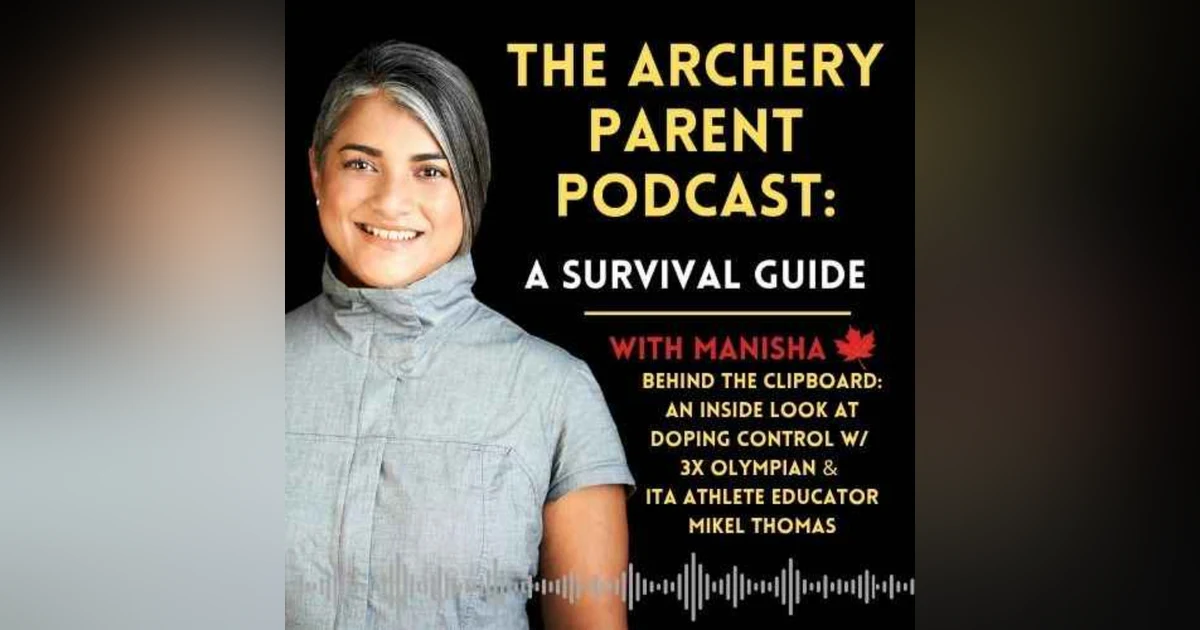
Doping Control Rules for Archers & their Parents | The Archery Parent Podcast with Manisha
Doping Control Demystified: ITA Educator Mikel Thomas on Testing, TUEs, Whereabouts, and Clean Sport
Have You Ever Wondered What Happens When a Doping Control Officer Shows Up at an Archer’s Door?
This episode is going to demystify the Doping Control process and hopefully answer some of those burning questions. Manisha interviews ITA Athlete Educator and three-time Olympian Mikel Thomas about Doping Control and Clean Sport.
During his 15+ year career in Track & Field and Bobsleigh for Trinidad and Tobago, Mikel has been tested more times than he can remember. He has lived it and now as an Athlete Educator, he takes athlete's through the process from notification through to sample collection, privacy, minor safeguards, and an athletes’ rights. Together, we cover who can be tested, Registered Testing Pool (RTP) requirements, Whereabouts, and how missed tests and “fail to comply” can lead to violations. Manisha and Mikel also discuss the risks of buying supplements and medications from another country and cannabis rules in sport.
Mikel emphasizes the responsibilities of an athlete for substances used in and on their body, declaring medications/supplements, using Global DRO, and obtaining Therapeutic Use Exemptions (TUE). The conversation also links sport integrity to athlete branding, highlighting Mikel’s “Off Track” project and Athlete Brand Playbook, and how he helps athletes build monetizable brands through authentic storytelling, NIL awareness, and IP ownership.
00:00 Welcome & Introduction
00:36 Meet Mikel Thomas
01:56 Who is the ITA (International Testing Agency)
02:27 DCOs & Chaperones
04:08 Testing Basics
05:25 Who is Eligible for Doping Control
08:27 Random Testing Reality
10:35 A Step-by-Step Process
13:59 Medications & TUEs
16:37 Minors & Safeguards
18:39 Applying for a TUE
21:51 Declaring Supplements
23:50 Whereabouts & Avoiding Whereabouts Violations
27:53 Fail to Comply Explained
29:23 Buying Medications & Supplements While Traveling
30:04 Cannabis Rules
32:53 Clean Sport and Branding
37:56 Owning Your Athlete IP
40:06 Follow-up and Resources
41:39 Travel Tips and Wrap Up
Additional References & Resources
Bookmark these sites immediately to keep you and your Archer in the know:
- Global DRO: GlobalDRO.com – Type in a medication name and country to see instantly if it is legal, banned, or requires a TUE. There are variations from sport to sport and in-competition/out-of-competition.
- International Testing Agency: ita.sport/athlete-hub – Access clear, athlete-to-athlete educational webinars and toolkits.
- Sport Integrity Canada: sportintegrity.ca – The newly updated home for Canadian clean sport standards, therapeutic exemptions, and athlete rights.
- Mikel Thomas Branding: Reach out to Mikel directly to explore the Athlete Brand Playbook, digital presence building, and how to secure corporate sponsorships. Instagram and Threads: @mikel_thomas
A Cinematic Look at Doping Control
If you want to visually understand the mechanisms, pressures, and flaws of the global anti-doping system, add these titles to your next movie night:
- Icarus (2017): An absolute must-watch. An amateur cyclist and film maker attempts to self-experiment with performance drugs to see if he can bypass standard testing, only to accidentally stumble into exposing a massive, state-sponsored doping conspiracy. It perfectly illustrates how easily sample security can be compromised when systems fail.
- The Ben Johnson Story : Mikel explicitly noted this project. It re-examines the infamous 1988 Seoul Olympics scandal that forever altered the cultural landscape of "anti-doping" terminology and sports media scrutiny.
----
Check out the accompanying blog post for additional resources, an FAQ, and a run-down of this episode with Mikel.
Hosted on Acast. See acast.com/privacy for more information.
Manisha: Hello, Archery Family. It's Manisha of the Archery Parent Podcast. Today, we are going to talk about a topic that a lot of parents come up to me about. That is Doping Control. And today, we have Athlete Educator, Mikel Thomas, on behalf of the ITA, or the International Testing Agency.
Mikel is going to take us through the process, demystifying it. As well, we're going to talk about a project that he is taking on for athletes. Welcome, Mikel. Welcome to the podcast. Thanks so much for being here.
Mikel: It's an honour to be here, and glad to catch back up with you.
Manisha: Winnipeg, Manitoba, was hosting the World Archery Youth Championships, and we just happened to meet. You shared who you were. I shared a little bit about the podcast, and I extended the invitation, and I appreciate that you took the invitation up.
Mikel: No problem. Glad to be here. It was an honour to be there, and just continue to share as much as we can to make sure that parents and athletes as educated in the process and feel empowered in it.
Manisha: You have many, many hats. I have alluded to two, but please share with our listeners and viewers who you are.
Mikel: Yeah. I've had the honour of representing the beautiful twin islands of Trinidad and Tobago in two sports, actually, on the winter side in Bobsleigh and in Track & Field, spanning four Olympic Games. To be able to do that as an athlete, and then was always curious about how athletes are a part of the movement.
Took that approach into trying to figure out how we can better serve rather than police the sport, and just spent some time in Switzerland in the heart of the Olympic movement and helping build a Clean Sport program. Then went on to do a lot of things on the brand partnership, corporate side of things, and even now I'm calling to you from D.C. where I'm with Monumental Sports doing a lot of work across all of our properties on the partnership side.
So it's been a journey throughout sports, each one trying to figure out how I can best serve and make it better than when I was in it.
Manisha: And can you share who is ITA and what is their role in doping control?
Mikel: ITA is the International Testing Agency. Many would know of WADA, but ITA is another independent agency that gets contracted out to pretty much serve on a couple of fronts.
They will execute the Anti-Doping programs, so from testing to results, DCOs, and also education. And so a full-fledged system of protecting and honouring the sporting ecosystem as much as possible.
Manisha: Let's just begin with the process. Let's talk about who makes up the team.
Who are DCOs and who are chaperones, and what are their roles?
Mikel: Yeah. A Doping Control Officer, DCO, is pretty much the person who will conduct a lot of the tests. A chaperone is someone that will come and accompany the person to protect the integrity of the test and the safety and well-being of the athlete involved. We want the first introduction to Anti-Doping or Clean Sport be education, not necessarily a stranger.
So that's why we really are excited about programs like this. You know, I helped do this actually for my Master's degree to now still implementing it across the world. And so it's the idea of making it Athlete-to-Athlete. So I've lived the experience. I've went through it.
I've been in the Registered Testing Pool. Once you reach a certain level. I've been tested in the NCAA. I've been tested internationally. And so having that lived experience and understanding what could potentially happen, but then also the rules, the programs, and the rights and regulations in which athletes have, and then making it palatable. So, translating all of these documents and all these processes and procedures to make it human for athletes to feel empowered by it.
Because, like I say, I try to more so “firefight” than police the sport, and so it's a lived experience of - I think we all can kind of tell when a police officer enters the room versus when a firefighter enters the room. So it's one of those things where we want athletes, parents, the ecosystem to be equipped when and if something was to happen, that you know the process and procedures that you need to do to move forward.
And so that's the whole mission of it. It has to happen. It will happen. But how do we feel empowered in keeping our sports clean?
Manisha: Actually, how many times would you say you've been tested?
Mikel: Uh, I mean, I've, I've produced times in Athletics as high as, like, number five in the world. I've been ranked in the Top 20, In my biggest year, and it's, again, it's one of those things where it's almost like a badge of honour. So I think the most I've been tested in one single year, probably like six to eight times, and that's between out-of-competition testing, where someone would come to your home during standard Whereabouts, and then to in-competition testing after certain performances are done to be ratified.
I'm the national record holder of Trinidad. I actually did it in Canada at a Pan American Championships, to World Championships, where you may have to do, blood samples because there's a biological passport. So your standard sets your future standard. And the system kind of regulates and, and checks and monitors that along the way. So you have urine samples, which is the most common, and then of course you have blood samples, more expensive, more exact.
And then you have A and B test that's given in both, so that if anything was happened with A, there's an opportunity for an athlete to request the B to be sampled and justified. So all of those are little pieces of the process that you want more people to understand.
Manisha: So let's talk about eligibility. Who is eligible to be tested?
Mikel: Almost anyone who's able to be on a national team or a particular world ranking. I would say world ranking sometimes first, national team second, because sometimes, you can rise in the world ranking before you make a national team. Youth athletes are particular in this.
And so you would have your National Anti-Doping Authority, your NADO. They would be responsible for pretty much regulating the ecosystem locally. And then you have your international partners like WADA or ITA, who would, once you enter international competition, they would be supporting that. They always will work with respect to the Regional or the National NADO, or RADO, Anti-Doping Authority in that area wherever that major competition is happening.
But like I said before, it's almost like a, a rank of honour. So if you are rising in the sport, if you are on your way to making a national team, it comes with the territory.
Manisha: So in Canada, we have the Sport Integrity Canada agency, which is formerly the Canadian Centre for Ethics in Sport. April of last year, 2025, they did a branding change.
In the US, they have USADA, which is the US Anti-Doping Agency. You mentioned national team and international ranked athletes. Testing can also happen for student athletes. How does that get determined as well?
Mikel: Yeah, this is actually one that there's a couple of nuances in there. So most of the time at the university level, it is random.
However, if there is a performance attached to it, it needs to be official. And a lot of the time, university testing, it is not necessarily in correlation with the international standards. So they'll test for basic things, of course, but not necessarily going to the depth of what's on the WADA list. This happens, actually a lot in Track & Field.
When I say an indoor world record, for example, actually, there was a Canadian who broke the indoor world record in the 400. Forgot his name, but his world record wasn't ratified for a couple of reasons. If they weren't tested in a certain amount of time after a phenomenal performance, then that performance isn't officially recognized globally.
It might be recognized by the university system, so it's still the NCAA record, but it's not a world record. And so there's also a need for people to be educated because the NCAA doesn't cover those things. So if you know your child is capable of doing a global type of performance or one that would be recognized, say even if it's a Canadian record that's being done in the United States, it still needs to be ratified by a legalized Anti-Doping test, and you may have to travel to a place in order to go get that test done so that the record could be ratified.
So it's one of those things where the original question, first it's randomized, and then of course it's performance-based, and then of course it's event-based that happens.
Manisha: I am very often asked, "Is it truly random?" How can you answer that?
Mikel: I can't. As an athlete. As an athlete, it never feels random. It always feels like it's you.
Again, take it as a compliment. I hate the word “anti-doping”. Let's be honest, since the '80s, it's had this negative stigma, and now there's actually a new Ben Johnson movie coming out. But it's like the idea that “anti-doping”, “anti-doping”, it's like you're negatively speaking towards a process that you don't want.
Why don't we speak life to what it is that we do want, clean sport. I have been able to see when I do a lot of the education, especially with younger people, they're way more receptive to the idea of clean sport because it's empowering. By saying “anti-doping”, there's only so much I can do. I can be "anti" in it, but there's no necessary action that I can do.
For clean sport, there's an ownership of how by participating in this process, I am doing my part to keep the sport clean. I can't control other things. Now, I do understand that there's some ethical things that's also coming on. In the US, there's this big thing around betting that's entering sports, and of course these mock things that are probability charts. I am concerned about the integrity of our sport moving forward, especially on the professional side of things.
So I do understand that there's a need for us to start encompassing more. But when it comes to the anti-doping, I think there's a way for us to stay more so clean sport or pure sport, or however we do something that focuses around what is beautiful and powerful of the sporting body movement. But randomized, it should be, it's supposed to be.
I also feel like it shouldn't. The thing is, the system is not always financially secure and stable to be able to conduct these amount of tests. We have to recognize the limitations that happen with there.
And then timing. Let's be honest, many of us wish that we can get results before the championship is over. So there's still a need for the system itself to be improved, modernized, updated, but it's going to require participation and support from the whole ecosystem to be able to do that. We're not there yet.
Manisha: So let's just go through the process. My son is on the Canadian national team, and he occasionally gets selected for doping control. So someone with a clipboard will walk over to him, ask him to identify himself, and then read a notification stating that he has been selected for doping control. What happens after that?
Mikel: Every athlete, especially if they're under 18, has the opportunity to request a team body member, say your medical support staff that would be there, your coach, or your parent, if available within reach. Sometimes accreditation might prevent them from getting to certain places. And so once you're under that age, you have that ability. Even if you're over the age, you still also have that opportunity to have someone accompanying you.
The moment they come to you, the process has begun. Don't ever try to let them leave. That's something I think some people have gotten in trouble with. That's called evading. Now, in that process, once they've introduced yourself and they've officially started this procedure, if you have press interviews or requirements, if you need to drop off certain apparatuses, things like that, you still have the typical duties within your sport that you're able to execute.
And then you have the ability to then proceed to a secured facility area on-site that they will then start going through the actual anti-doping process, where there will be materials in which the athlete will be presented.
Normally, when it comes to serial numbers, the full process, and things of that nature, they're fully aware. This is a private area, so there shouldn't be any filming involved, both from the athlete and an outside media perspective. We must keep this area secure. But the athlete is sat down, educated about what's about to happen, given a set of material that only they will touch. That's important, for, again, purity purposes.
And then they will start going through the process and validating material. So does this code match this code? Okay, you agree that this is right. Is it legible? Does this device or apparatus look damaged? Do you accept it? I want a new one. You're capable of requesting that.
And then you would proceed to give your sample. Majority of the time, it would be urine first. Normally, there's a little bit more notification if there's blood, but if it's urine, you would then proceed into a restroom area. This part is a little awkward. I'll be very honest with you. There is a need for you to do a little bit of a verification that it's only you in the restroom at the time giving the sample because, again, things have happened in the past where people have come up with devices that have sample urine from somebody else. So it's just a verification that it's only your human parts participating, no touching.
And then the athlete will give their sample of a certain amount. A certain amount of a certain clarity is necessary, as well. If it's too light, unfortunately, you would have to resample. If the athlete doesn't need to urinate, unfortunately, we would have to wait.
I've seen people be in the doping control process upwards of, like, 16 hours, if necessary. Some can get it done in an hour. It all depends on each individual. But then once the sample is given, you're pretty much able to pour into the vials. The instructions will tell you exactly what they need at the time, and then you're able to put it in your A and your B sample in a securely sealed compartment with a plastic seal that will go directly to labs.
And you will be verifying this process the whole time and signing it off. Things that athletes and parents should know is if you do have medication or if you do have supplements that you take, you should have these things written down in your Notes app or availably submitted to your team member.
Someone should be aware because there's a portion of it that if anything was to pop up, that it would make sense. If you do have a medical condition that requires some sort of advanced medication, whether that's asthma or ADHD, very common, or any other medical condition that you may have, and you have not already submitted a TUE, it’s a Therapeutic Use Exemption, it allows you, because of your need to function as a human being, you need X-amount of medication, you have the ability to do so. Preferably, you've already submitted a TUE.
There are also cases for emergency TUEs. Say you're traveling, it's the wintertime, you got a head cold, you took something. Still be aware of what it is that you're taking. You may need to make an emergency request submitting that you have this, or you took this a few days ago. Those are things like that.
Always seek first advice of your team member, and always contact your local Anti-Doping authority. Be aware as you travel around the world, the active ingredients are not the same, even from Canada to the United States.
So what would be legal in one country is not legal in another. Again, especially between as simple as Canada to United States, even places amongst Europe. If you go into Asia, Latin America, there are different active ingredients. And so there is a WADA list. There are certain sites like Global DRO that you have the ability to verify these things because the athlete has full responsibility for everything that comes in and on their body, so you must remember that.
So just being aware of just those little things. It does seem tedious. It's right now what we have to do to best keep the integrity of the sport going. And it's just one little piece. It's just steps. I think once we get used to the processes, it becomes a lot easier to kind of just execute on them.
Manisha: Right. There are so many Archers, specifically, who they will actually not go to the washroom even though they have to, say, during matches or a qualification round, just in case they have to be tested. That way they just speed up the whole process. Nobody's waiting extra amounts of time. But it is very, very common for athletes to hold it just in case, and if no one with a clipboard shows up, then they go.
I just want to go back about minors. Around the world, does the age of a minor change, say, from country to country? In North America, typically it is 18, but is there a chance that a minor could actually be a different age?
Mikel: For the most part, World Championships, Youth Championships, Under-, particular championships have a set chance.
So like an Under-18 Championships, every one of them are generically considered a minor. Normally, you would go under the registration or the, the law of the land, so whatever the local NADA would supply. But you can expect that Under-18 on a general basis, would be considered a minor.
So the system is also fully aware of those circumstances at the event that they're going to. Now, can a Under-18 participant make it to an Olympic Games? 100%. So that's when you should know what your rights are, like, gymnastics, for example. Very, very young population, but that group and population should be aware of what their choices are.
Manisha: What is the triangle when it comes to observing a sample being provided by a minor? Typically, there is a third person in that observation area. Can you just explain that a little bit further, the purpose of that?
Mikel: So if the Doping Control Officer has their eyes on you, the athlete, the person giving the sample, the third person has their eyes on the Doping Control Officer, and there's always, again, clear distance between.
No one is touching you At all. No one should be touching you at all during this process. So if the athlete is here giving the sample in the bathroom, the Doping Control Officer would be here watching them give the sample, and then you'll have your third person who will be there kind of watching them watch them.
So you'll always have someone with eyes on someone, with distance between everyone. And so then you can give your sample, you can finish, place everything in a cup, and you can continue to use the restroom as necessary. But that's just the main thing. Someone will always have eyes on a particular party member with distance between them.
Manisha: And can you just explain when you referred to the TUE, who would you register that for? How do you apply?
Mikel: Yes. If you are any way at all concerned around your medication, first person to see is your medical team advisor, your doctor, and your team staff. Normally with each one of your national governing bodies, you should have at least the ability to have a doping control educator or officer within the team that would help register and move those things.
And so once you've found out, I think that's also something very clear, because let's be honest, like ADHD medication is probably one of the most common one or some forms of asthma medication. If you are even concerned, you should just go ahead, flag it, and submit these processes. Right now it's, it's pretty simple.
It's pretty much like an online thing. You would get verification from your practitioner, so your own doctor who gave you the prescription. You should also make your doctors aware and your practitioners that you are in the global sporting ecosystem because many are not aware. And then if they are, they can potentially give you another prescription.
It's still something I also wish was a little bit different. I've come across very few doctors who are fully aware when it comes to prescribing and the sporting body. But once I do, like that's my doctor. But it is something that if you do have a practitioner, you should let them know that, "Hey, I am a international athlete. I'm a national athlete." I, I just need to kind of check these things, or I will need to come back to you to get some materials to verify that I need these particular things. And then it's pretty much like an online process where you would submit, and you would find out if it was granted or not. I would do this as soon as you have any one of these ailments, any one of these conditions, any one of these prescriptions given to you ahead of time, because there are moments where there are things that are banned in-competition, out-of-competition.
It can be very nuanced around what's legal, what's not legal, when it's legal, things of that nature. But if you have already submitted the TUE, you're kind of covered for the different purposes and the different times that you kind of register for. And again, you are allowed emergencies.
Say you left your medication, you become sick, whatever the case may be, you are allowed to kind of file those, I would say, almost as a cushion, as safety if you're not sure of the process or the medication that you're there. Hopefully you wouldn't need any. I wouldn't want anyone to be in those type of situations.
But, I've known athletes who, for example, suffered from seizures, or they may have had some sort of emergency happen at a major event, and they didn't have their normal medication. Those things can happen. We're human. We're still living. It's a, a case of emergency break, but think of it as an insurance.
I will also say there have been some who have taken advantage of these TUE circumstances, from growth hormones to different steroids that may be necessary in life for other people, but advantages for others. That's where, again, integrity units come in to do their examinations and investigations to verify the different medical uses and purposes of medications.
So everybody does have a role to play within this ecosystem, and that's how one can do their job to keep the integrity and, and the purity and the cleanness of the sport.
Manisha: There is a section where all medications and supplements within the last seven days need to be declared. Not everything that you take, if you are taking something, has to have a TUE.
So they’re - they are the same thing in that they all have to be declared, but that they are also separate. What could a supplement, for example, be that someone would have to declare?
Mikel: Supplements is one of those cases where there's rarely a case where a supplement is prescribed. There are some who would have alternate forms of medications, uh, when you're talking about herbs or different remedies.
I would consider, again, just making sure you have those things marked down on paper so we can be fully aware what active ingredients are potentially involved there. But honestly, I feel like supplements is one of those areas not as regulated and as protected, as it could be. We do have NSF in the US, and we have a couple of Safe Sport, but even then it's, it's still not 100%.
A third-party batch tested would be a great place to start, but even then things can happen in different samples. So it's almost like you want to just keep a trail for yourself.
Manisha: In the process, you do need to have ID. So if you don't actually carry or have a Driver's License, for example, you can take a photo of your passport. You can take a photo of your driver's license or other form of photo ID, which is preferred.
Mikel: At major championships, for most, your accreditation counts because in order to get an accreditation, it must be validated. That's why I was saying keeping in your Notes all of those supplements, all the things that you take, because in the process, like you said, in the doping control process, you will have a portion where you'll be putting in everything that you take seven days or beyond, anything that you are actively taking or have taken.
People will carry their phone before they carry their ID, right? So always have in your Notes or somewhere that you can actually put these things whenever needed. And this is also if they were to do an in-home test, uh, which is a whole other conversation.
Manisha: Well, let's just briefly talk about that. So what is the difference between out-of-competition and in-competition? You have referred to it earlier, but these DCOs can actually show up at your house. That is what has happened to us a few times.
Mikel: Mm-hmm.
Manisha: So let's go through that.
Mikel: Congratulations, you are now a part of the Registered Testing Pool, and this is normally a select group that tends to be either your high elite or your emerging elite athletes at a particular ranking. That is the highest probability of being at these major competitions.
This is part of the Whereabouts process. So an athlete must submit where they would be, throughout the year, and give their own choice of when they would prefer to be tested. Many athletes, and including myself when I was in this pool, I would choose hours in early in the morning because I know I'm sleeping and I know I'll be home.
So whether it is at the training venue, your own personal residence, your parents' residence, like you said, somewhere that you know you will be at a particular day and time and that you have the ability. Yes, you can change these things normally within a certain amount of time before, but we have had cases where an athlete said they're going to be at X and they were at Y, and they missed the opportunity.
And once an, a Doping Control Officer shows up, there'll be notification, and then you have a certain period of time to kind of show up to get the test done. That's also part of the process. Now, this is normally out-of-competition type of testing. And when they will show up, then they will take you through, again, very similar, the same process as you were before within your own home.
And this could be urine or blood, but most of the time it would be a urine sample. The purpose of this is to, again, just keep a almost a 24/7 approach to anti-doping and clean sport. And so the same process will happen there, where you'll be able to then go through the process of, hey, here's the same material, fill out the particular forms, conduct the tests, and go on.
If you're under 18, and you are in your home, your parents will again be that third-party person to be involved in the process to make sure everything is kind of triangulated and safe and secure. The biggest thing for me, and the biggest concern is just updating your ADAMS and your Whereabouts.
That has been the biggest thing. We've had too many athletes, there's probably more athletes who suffer from Whereabouts violations than actually doping violations. The problem is news reports it as you failed an anti-doping violation, and that I think is as damaging as anything in that you have three strikes and you're out.
So I don't want you to play with any of them because I know sometimes you may have illnesses or maybe you spent the night somewhere or you had a delayed flight and things can happen. So never take advantage of this whole three-strikes-you're-out. I'll just truly be on top of it as much as possible. I know people who, if they have agents or parents who are fully involved, they allow them to kind of monitor their schedule and kind of help add into those system.
That has been helpful. I've used my agents in the past to really help because they know where I'm going to be a lot of the time. Just make it a team effort. Honestly and truly because you don't want a simple thing as a Whereabouts violation when someone shows up at 5am, you should be sleeping.
Great time for you to use the bathroom because you probably need to first thing in morning. Things like that you want to think of versus, say, a training facility or a venue that you may or may not necessarily be in at the time. It is a process. It's one that I know athletes are not the fan of, but it is currently, uh, just something that we would have to continue to maintain to do and be aware of.
Manisha: The language behind all of this as it's presented in the media, you're right, can be very damaging and very easy to misinterpret. This swimmer, she had three violations within a year, and those were Whereabouts, and as you've indicated, where she says she was going to be somewhere but was not, and when a DCO showed up, she was not there.
So that in itself is a violation. But can you talk about Fail to Comply? What does that mean?
Mikel: Yes. Fail to comply is, is a big one. In the process, if you delay, slow down, hinder, avoid the process, it can be a serious issue. I've heard of cases where people have tried to change the venue or the location.
They try to get people, not a chaperone, involved in the process, and now that person is hindering the process. Something to truly be aware and cautious of. Some people have made threats to DCO officers. I get that you don't necessarily want someone to come to your home, but it is part of a process, and they are supposed to show ID and make fully aware of who they are in, in this.
I get a level of concern, but still we're human beings. Treat people with a level of respect and, and not want to try to put yourself in a situation where people are chasing you down, continuously over and over. Some people have taken advantage of the fact that, again, DCO would follow you in a competition, and they would delay that actual test.
There's a difference if you're sitting in the room and you just can't pee versus we're running around a venue acting like you can't do a simple anti-doping test. Honestly, I'd rather you just get it done and over with. Submit your sample, go about your day. But we see constant videos of people at an Olympic Games, they just finished the last event, and they don't get home till, like, 3:00, 4:00 in the morning. This is one of those things.
Manisha: If you are away at a competition in a different country and you need to seek medical advice, athletes that go to a different country will actually not want to take the medication that is prescribed to them in a different country because they are so terrified that it will come up in a test.
As a traveling athlete, make sure that you bring someone who represents you especially if you're not able to speak or if, you're puking and not- ... able to really be with it. Make sure that if you are needing to seek medical advice in another country, that you get all the notes, you get sign-offs, and you keep all copies digitally, as well as hard copy if possible.
Let's talk about cannabis in competition. Certain countries it is legal, such as Canada. Let's talk about cannabis there.
Mikel: Yeah, that one is so nuanced. In North America, it is varied state by state. Under the WADA code, it's varied sport by sport, in-competition, out-of-competition.
There's, like, a period of when it cannot be allowed in Athletics. It's a totally different period for Archery, totally different period for Squash, totally different period for Curling. And so that's also, I think there's a, there's always a consideration to the needs and the demands of your respected sports. Let's be honest, the effects of THC in your bloodstream, if you had a apparatus, I don't know, like a bow, it could, cause some issues for the venue and people around you, right?
And the same thing, like, if you're doing something like in anything within the winters, you're talking about heights and depths. There's always that consideration of the period for the particular sport, as in what's allowed and what's not allowed.
Because I've seen different time periods for, like, Equestrian, for example, which is also interesting because you have the Athlete-Horse and then you have the Athlete-Rider.
There is rules for the horse, and there's rules for the athlete, the Rider-Athlete. And so that's why the code has been really meticulous about really diving into what are the respective effects of it. Because again, imagine a horse with a certain level of THC in a venue that's doing jumping, for example. That is dangerous, right? Same thing with the Rider-Athlete.
It's not just those who smoke. We also have to recognize there's gummies, there's edibles, there's different ways these things can be consumed. Unfortunately, knowing and unknowing, right? So be aware of your friends, be aware of your situations, but you are in charge of what happens and into your body.
If you had to partake, I would only say, one, make sure you know your rules, regulations, and your particular sport's time period. Off-season is the only time I would even consider something like that. There are those who do have medical conditions, from cataracts to certain those that suffer from seizure and different depression things.
Those can also be TUEs, if it has been prescribed. You have rights and rules and regulations, but you have the ability to trust the system if you know the process. You've really got to dig in to your particular sports. Really, really do.
I've seen windows as much as two weeks. I've seen windows as short as 48 hours. So it all depends on the sport that you're in, educating yourself, educating those that are around you as much as possible. And if you don't have to, I would highly suggest you wait for another period of time. Once you're retired, you can manage your body and your time as much as you want to.
Manisha: Speaking of managing your time and your body, you also help athletes brand themselves, make themselves a monetizable brand. You have worked with companies like Visa and Airbnb. What is the relationship, if there is one, between a clean sport athlete representing the integrity of fair play and being able to brand yourself?
Mikel: I think that's actually a huge opportunity. I'm going under this thesis that in 1984, changed the sporting landscape. That's when LA hosted the last Olympic Games, and that's the first time an athlete became sponsorable. That's when we became household names. I believe, and I'm betting on, it's going to happen again in LA in 2028, because, again, it's the biggest stage.
So I would love more athletes, parents, coaches, sporting bodies to be ready for the shift of media and the ability to truly brand and own that. So when it comes to, like, clean sport integrity, like we said, there are many supplement companies that are trying to get validated in a very congested market.
Well, the affiliation with a very authentic, strategic athlete would be perfect. It gives them both validation. Now, the, the thing though I would want to caveat, and again make people aware, is you cannot 100% guarantee the results if there are active ingredients or even potential contamination. Because a lot of the things that people don't know is, supplement companies, a lot of the time it's manufactured somewhere else, where they're manufacturing a bunch of different supplement and food and beverage industries, and then they're just making packaging to you.
Anytime you see "may contain nuts" or "may contain milk" means they don't control the process. So that's something that's where it can happen. But from a branding perspective, not just within anti-doping, it's whatever's important to you. You can find your appropriate person, the right partner, the right organization to kind of come along.
I think it's an opportunity also to s- tell your message, tell your stories. There's a lot of brands, there's a lot of athletes, but the ability to be authentically yourself is of what's going to give you the greatest separation. And you don't need one person to give you 100,000. You might get 10 people to give you 10.
And so I think sometimes that's also where you divvy it up and you find room for individuals. You tell your story. You show the behind the scenes. Being at an Archery event is very different than seeing it, right, on TV or watching it. Like, you have to sit with the parents. You have to see with your own eyes exactly how far they're shooting.
You got to see the strategy that happens when you can feel a gust of wind. But no one is telling this story. No one is showing you the, again, the behind-the-scenes of what's the mental. What does it sound like when you shut everything off, you hear only your breath and your heart, and you release? See, I just made it cinematic.
I need the athletes to do much of the same, and then you can find someone. Like, if you look at the pillars of the sport of Archery, you're talking about precision and excellence and, and performance. But I just named, like, a car brand. Like, why couldn't that be a partner? You know, I just talked about a luxury watch. Why can't that be a type of partner?
So once you find, like, what's the pillars of your sport, what's the pillars for me as an individual, what do I stand for, what do I want to represent? And then you look for the brands and the partnerships that match that. And then you go on this journey of telling the story, not just of the moment, but the movement that we provide together.
That's what I would love to see more people give. There's enough companies within North America. There's partnerships for everyone. You can start with your local Mom and Pop. I advocate highly for being effective and active in your local community. And again, you can start with small packages to really show that we're going to take Calgary to the world.
I'm going to go from one west-end city to this whole part. We're going from local to LA. You can create that type of roadmap where a company would benefit from a larger platform, especially where Archery goes. Man, you guys go all around the world. You guys get some amazing shot in urban cities in Europe. Just ways that we can better incorporate, and that's what I would love.
And with Name, Image, and Likeness, the way things are right now, I think more parents need to be educated about this process because a lot of athletes are being taken advantage of. But in the same sense, there's a lot of room for people to fund a dream, that I say. Because I know it's not cheap. We do not get paid enough, but a lot of it is because the story hasn't been told in the old ways.
I'm seeing the same conversation with a lot of organizations. People are volunteering. They're not able to move as fast. But an athlete, a family, a unit has the ability to tell their story, and if more and more of the athletes do it, then the events and the organizations will start to change.
Manisha: I love that. What is the brand that you are marketing this under?
Mikel: We're Off Track, where literally we focus on everything that's a little bit off. I believe that it's actually more beyond branding, because what an athlete has, especially if you think about this digital media world, is we have proof. We have proof points.
If someone says, “I follow my training plan, and you can get results like me," that's only me doing what you've done. But like most athletes can understand, there's several ways they work with coaches. They have the results to show that, well, yeah, this is how you perform at this level. This is what my coach does. This is what I've done. This is what I've seen, and I can kind of do that.
And so I'm also trying to help athletes understand this idea of IP. I work with brands, I've worked with top properties. And a brand partnership, though I just went on the horse for brand partnership, that's in somebody else's control.
Social media: if Facebook and Instagram was to shut down today, well, so there goes your following. So there's ways that I think athletes are also able to take things offline or in the real world. So if you do have an event, like bring your following, have a pop-up, have a meet and greet. Can you do an e-book that shares the insight of the mentality of how you have short-term memory to try again?
Like from round to round within Archery, you literally either have to have a locked in what went well and totally forget what went wrong, and that can happen in a matter of minutes, not days. We don't have the ability to sulk. You have to transition between I learned what I needed to learn from this moment, here's how I'm going to implement it now.
That's a life principle. Now, can you bottle that up and own that process, that product, market, service or solution and give it back out to the world? I would love more athletes, families, units to start thinking of themselves as a business. And then we're actually providing, yes, Name, Image, and Likeness, but on top of that, all the power and beauty of sport now delivered to help different needs of different people So that's the goal.
Manisha: Where can people find you to ask you to expand on that a little bit more.
Mikel: Absolutely. First off, you can follow me on Instagram, mikel_thomas. We're building this out literally because I've been having conversations, and I recognize that there's a serious gap. I'm betting on a few things. I'm betting on media, athlete-centered voices moving forward. I'm betting heavily on women's sports because I think women can tell stories that respectfully men can't. I'm betting on the idea of IP ownership is going to look a lot different moving forward. If you look at the top, you will see most of the top athletes own their own media brands. There's a reason why. And even most of the top sports teams own their own media studio. There's a reason why.
I think it's time to start trickling that down. So where I've worked at the top, and I see the way the, the sport and the industry is going, but I also recognize that the need is almost at the bottom.
Like, to have $5000 to afford something when you're trying to make a national team is a life. I've been in circumstances where I had to decide, do I want to buy a new pair of spikes or pay this water bill? It's tough in the middle. And so there's a lot of people where if they just knew a lot of these options. Follow me, DM me, and get ready because one of the biggest things is our Athlete Playbook, help people understand what are their digital presence is, and then how to make this tangible and real to where we can commercialize and commoditize communities.
Manisha: Thank you. I usually close the episode out by asking two questions. As someone who readily flies around the world, has traveled extensively, what is your best travel tip?
Mikel: Best travel tip is put everything in your carry-on. If you could. I get sometimes you need oversized travel, but if you could put your necessities in your carry-on because it's, it's not when, they will lose your bag at some point.
So if I can keep my bag with me, that's my number one, carry on.
Manisha: And my second question is, what is the one thing traveling that you never, ever, ever leave home without?
Mikel: Outside my passport, I, I would say one thing I never leave, when I was competing, it was definitely, definitely like my recovery tools. I think people forget how strenuous it is on your body to travel six, 10, 16 hours and then have to go compete the very next day.
There's a lot of tricks and tools towards that, but, like, I took that recovery process very serious, and it allowed me 15 years at an international level. And then personally now, my phone, my camera. I think the world is so beautiful, man. You get to learn not just about the world, but about yourself, and I've been able to really see some amazing things.
Sometimes it's such a blessing to look back and like, "Wow, yeah, I was, I was actually there." And I don't think we get a chance, especially as athletes, to enjoy the journey because we're constantly chasing the "next": the next championship, the next team, the next podium, the next ranking. And then you look back and it's like, "Wow," I was in Beijing or Shanghai, or Australia and Switzerland. Sometimes you got to really enjoy it, and that helped me to reflect back.
Manisha: Thank you, Mikel, for joining us today on the podcast. For parents, know that you are the first line of defense essentially when it comes to doping control, education around the doping control process. If you have questions, there are resources, ITA, WADA, Global DRO, which is D-R-O. I'm going to put all of these resources in also the blog and on the show notes.
And if you have questions about partnerships with brands, NIL, contact Mikel. He will give you the landscape, and he will share what he knows. And what's so interesting, I've been following some of your reels on Instagram, what you are talking about is actually quite transferable to even someone like me who is in a podcast situation connecting with sponsors and brands. The language is the same. It's just that people have to do it.
Mikel: Mm-hmm. That's the key.
Manisha: Thanks so much for your time. Have a great day. Thank you, Archery family. That's Mikel. I'm Manisha, and this is the Archery Parent Podcast.